Category Archives: Handmade Books

One Second of Time – A New Artists’ Book by Ginger Burrell

I am obsessed with earthquakes, or at least if you hear my husband tell it you would think so. I prefer to think of it as a healthy caution concerning a seemingly random natural event. Some of my earliest memories are of earthquakes – which makes sense since I’ve lived in California most of my life and, through some twist of fate, I’ve often been close to the epicenter.

When I am in a big warehouse store – Costco, Lowes, Home Depot – you know the kind with the miles of stock stacked above your head? – I think about earthquakes. When I walk across a parking structure – the kind that pancaked during the Northridge quake – I think about earthquakes. When I am on vacation – away from California – I think about earthquakes. Okay, perhaps I am a bit obsessed.

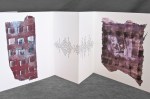
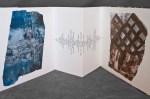
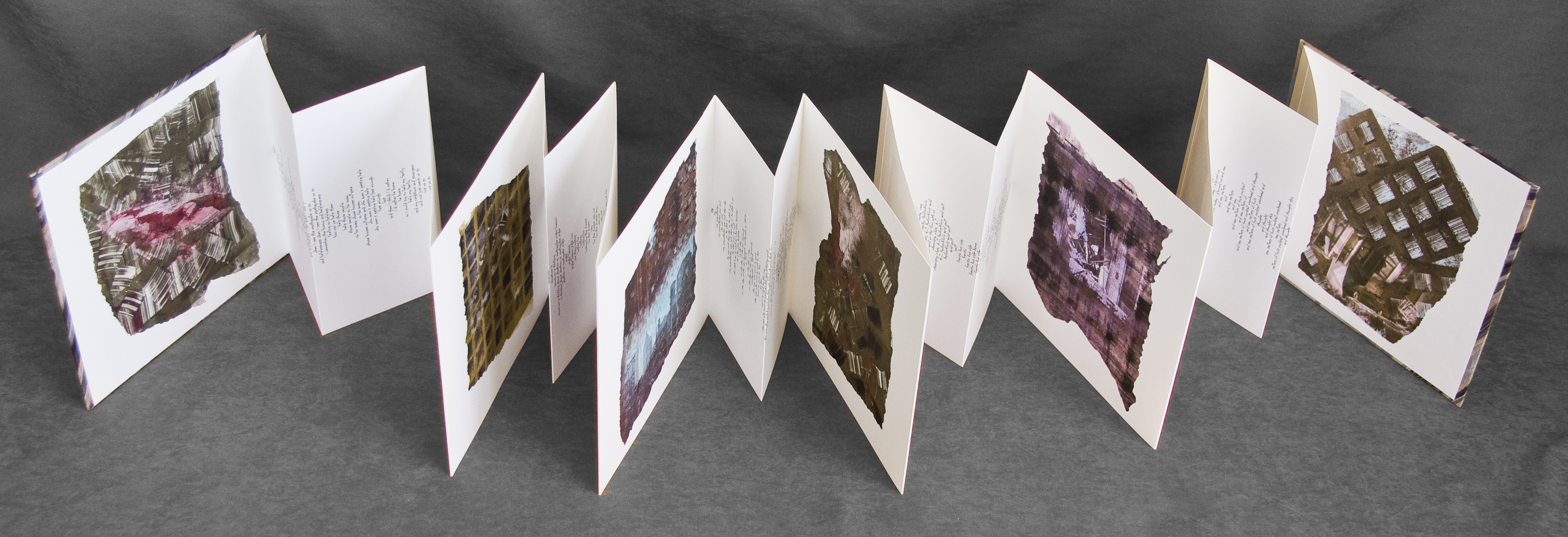
This book began as an expression of my hyperawareness. I created monoprints with jagged edges and a sense of motion and then combined them in Photoshop with found, public domain, images of earthquake damage. I then wrote poems to express my thoughts about earthquakes. 

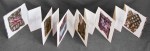
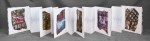
One Second of Time, an accordion book, is irregularly folded so that from above it alludes to the seismogram. The poetry is also written and presented in seismograph form. The book is printed on Rives BFK with archival inkjet printing. The font is Chiller. The cover paper, meant to evoke layers of sedimentary earth, is Pirouette Marbled Paper in black, gold and silver. One Second of Time is an edition of 10.

This slideshow requires JavaScript.

The title, One Second of Time, comes from a quote by Charles Darwin in 1839. “A bad earthquake at once destroys the oldest associations: the world, the very emblem of all that is solid, has moved beneath our feet like a crust over a fluid; one second of time has conveyed to the mind a strange idea of insecurity, which hours of reflection would never have created.”

If you would like to look at larger versions of the photographs in the slideshow, you can click on these images, here:
Your comments are appreciated.

~Ginger
www.gingerburrell.com

Chutes and Ladders Re-Imagined

One of my frequent  concerns as an artist (and one I hear from many of my fellow artists) is the sheer amount of materials I go through. Papers, boards, adhesives – so many raw materials go into book making. Each time I order a box full of Rives BFK or Davey Board I feel a twinge of regret for the trees that will suffer a beheading to support my pursuit of art.

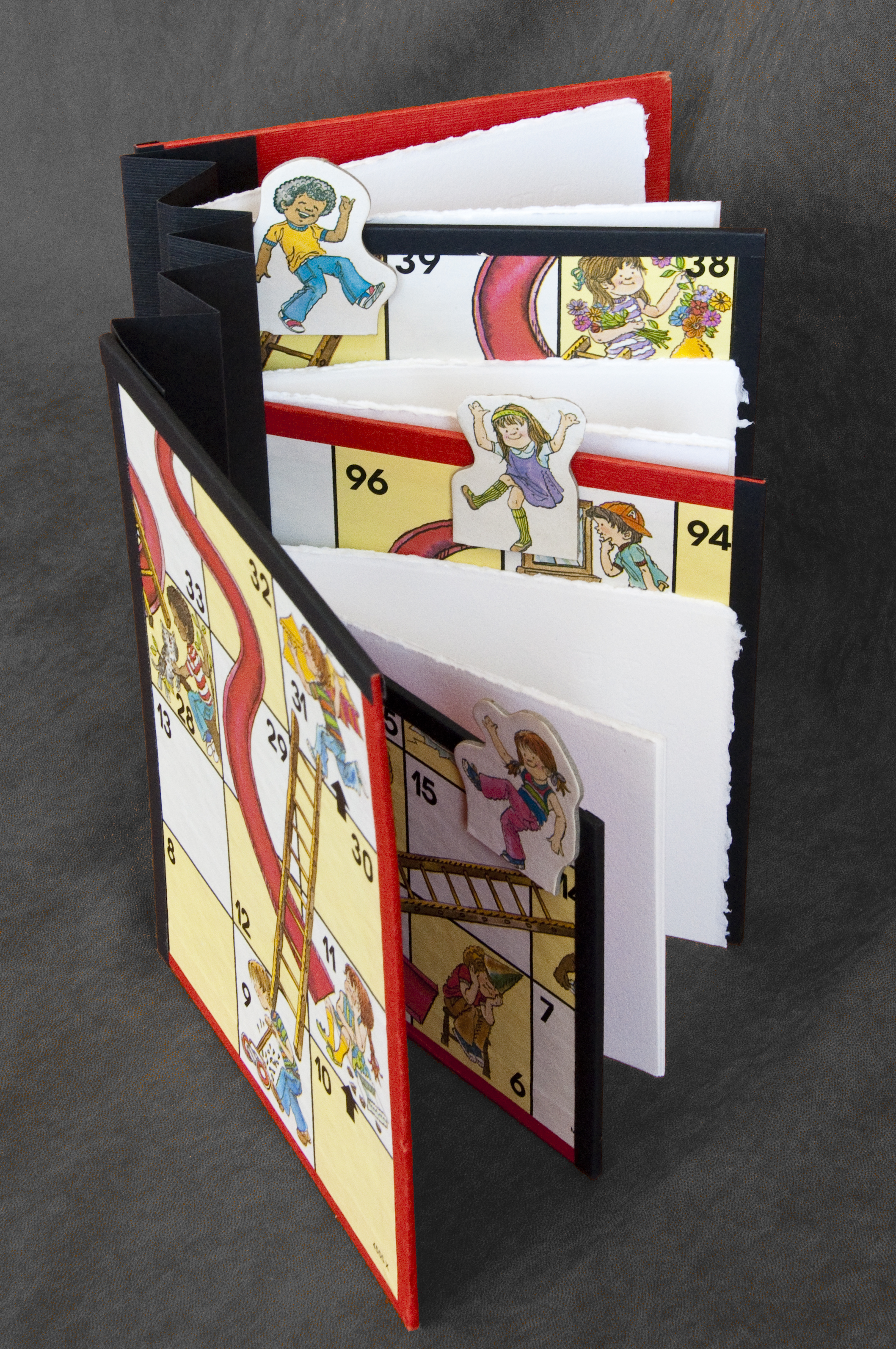
To challenge myself and use up those scraps of Rives, Davey Board and the vintage books and games I can’t resist at yard sales, I’ve decided to teach a class using only recycled and found materials. The class isn’t until September, but the Palo Alto Art Center needed photos to layout the catalog now. So this morning I went to my studio and started sifting through stacks of goodies I can’t seem to part with – the result is the book in the photo above – a re-imagined Chutes and Ladders.

The book is made with an old Chutes and Ladders game, scraps of Rives BFK, scraps of embroidery floss and scraps of black paper. So far so good – I’ve kept to my goal of not buying any materials for this class.

First, to really show off the game board, I decided to used pieces of the board not only as a cover, but also as section dividers. In order to show them off to best effect I made them graduated in height from 4 1/2 to 7 3/4″.  I covered the exposed board edges with thin pieces of black paper wrapped around them like bias tape. Next, to use those cute little game pieces, I decided to use them as “tabs” for my dividers. I glued them using straight PVA.

For the pages I cut three pieces of Rives BFK to the same height as the section dividers and twice as wide. I folded them in half and then used a pamphlet stitch to attach them into an accordion fold spine – so each section has 12 pages. I attached the section dividers and the covers using Terrifically Tacky double-sided tape and there it is, my first entirely recycled book.

I’m happy with the way the design allows the game to remain the focus and it was very fun to make a single book with materials on hand. It was a different exercise in creativity to design around materials I already had rather than design around an idea rattling around in my head. Instead of worrying about getting enough materials for an edition, I could focus on celebrating the materials I had in a single book. I’m looking forward to teaching this class in the fall!

~Ginger

www.gingerburrell.com

Paralyzed by Perfection (Or Turn it 90 Degrees)

I am in denial about being a perfectionist. The first time someone pointed it out, I was shocked – I’m not a particularly neat person (let’s go with “creatively messy”), I’m pretty low-key about many things in life — how could I be a perfectionist? Now, years later, I have to admit that I am, definitely, a perfectionist. Sometimes it serves me well – I have excellent attention to detail, I am willing to put the hours and hard work into a project to make it fit my artistic vision – and sometimes it is a real problem. 

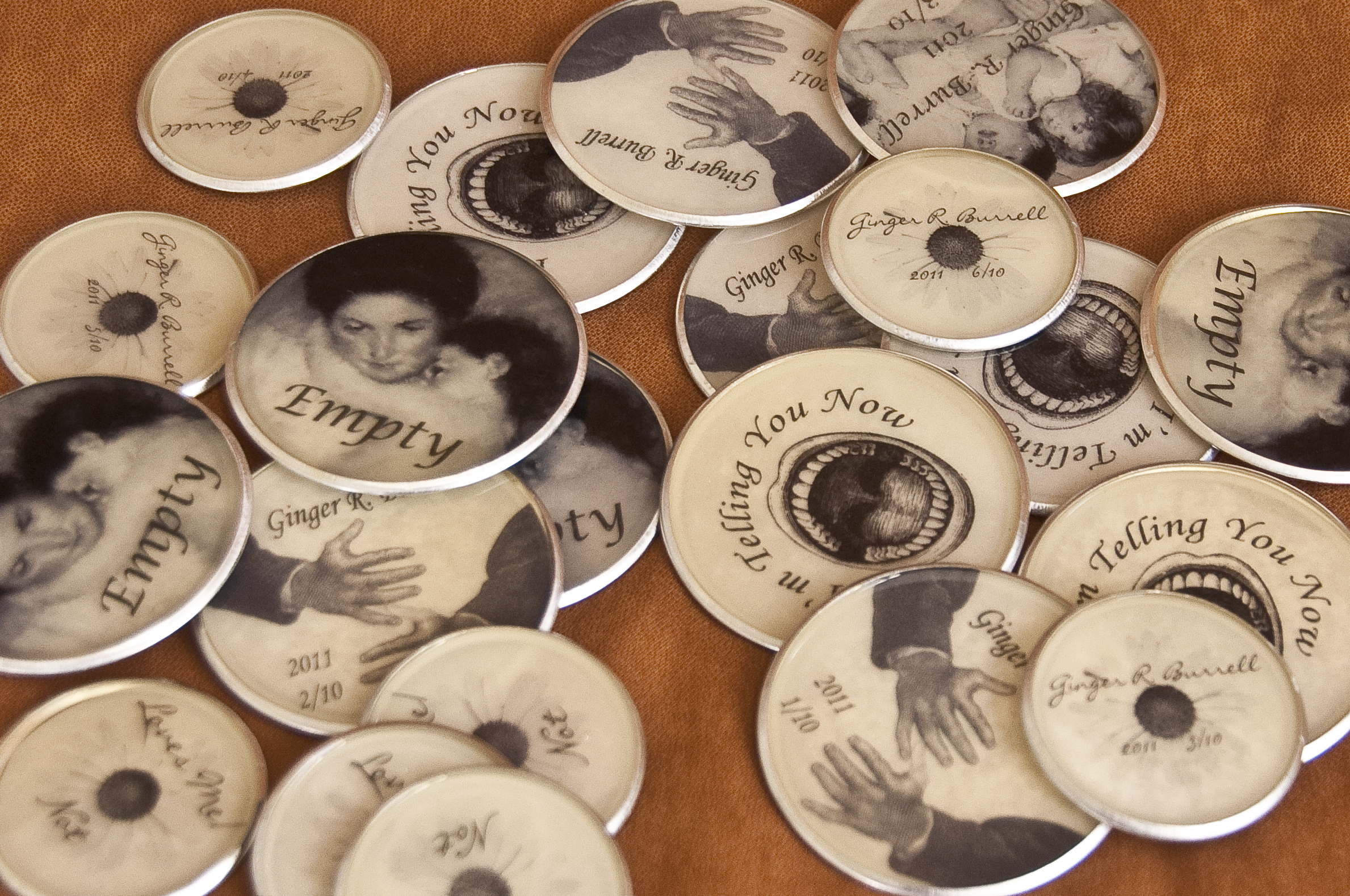
For the past several weeks I’ve been working on the labels in the above photo. It’s a technique using coarse embossing powder to create a translucent shell over an image. In the past I’ve used it to make a translucent disk and, at the beginning of this project, I tried to do that same process. I had all kinds of technical problems, finding a frame large enough (in the past I’d used metal washers), warping during melting, warping during cooling and, once I thought I’d solved those problems, I’d find out my sample pieces were the flukes and I really hadn’t solved the problems at all! To compound the issue, when I attached them to book covers, I realized I didn’t want them translucent after all – the adhesive (and any bubbles) showed right through.

Piles of ruined supplies later, I was so frustrated, I stopped working on my books. I kept missing one self-imposed deadline after another but couldn’t get myself back on track. I also couldn’t let go of that artistic vision that said these books need this kind of label. Sigh.

During this period of paralysis brought on by my own perfectionism, I went to the Maker Faire. If you’ve ever been, you’ll know it’s wonderfully overwhelming with a mixture of creativity that reminds me of a G-rated Burning Man. If you’ve never been, I highly recommend going at least once. They have them all around the country. But I am getting off topic as usual. Squirrel?

Back to the paralysis and piles of ruined materials. During the Maker Faire I had the opportunity to hear Fritz Grobe and Stephen Voltz of EepyBird.com speak. It was a fun and interesting presentation (you can have way too much fun wandering around their website) and, most importantly, they said something that will forever change the way I approach my artistic paralysis. “Turn it 90 degrees.”

Part of their process is to play with materials and, after hours of trying to get sticky notes to act like a slinky with no luck, they had the idea of turning the pad 90 degrees. That simple change (which took them hours to think of) made everything fall into place.

The next day, as I was sitting at the table looking at those labels, I remembered what they said, “Turn it 90 degrees.” Now in my case, turning the labels made no difference, but rethinking them from the ground up sure did. Rather than layering clear material with thin paper and more clear material, I printed on Rives BFK and used the heavy paper as a base with clear material on top. In that one change I solved all of my problems. The labels no longer warp, the adhesive no longer shows through and the paper backing allows for a better bond with the book cloth. Eureka!

Somehow solving that label problem unlocked my ability to solve the other technical problems I’d been having with other materials in these art pieces. Everything has fallen into place and I’m happy to say that I’ve finished almost all of the books I’ve been working on (that I’ve been stuck on, really). I’ll begin introducing them next week.

Thank you Mr. Grobe and Mr. Voltz. I now have a sign in my studio that says “Turn it 90 degrees.” I’m hoping in future moments of perfectionist paralysis that sign will spur my brain to creative mobility.

~Ginger

www.gingerburrell.com