Tag Archives: Ginger Burrell

Chutes and Ladders Re-Imagined

One of my frequent  concerns as an artist (and one I hear from many of my fellow artists) is the sheer amount of materials I go through. Papers, boards, adhesives – so many raw materials go into book making. Each time I order a box full of Rives BFK or Davey Board I feel a twinge of regret for the trees that will suffer a beheading to support my pursuit of art.

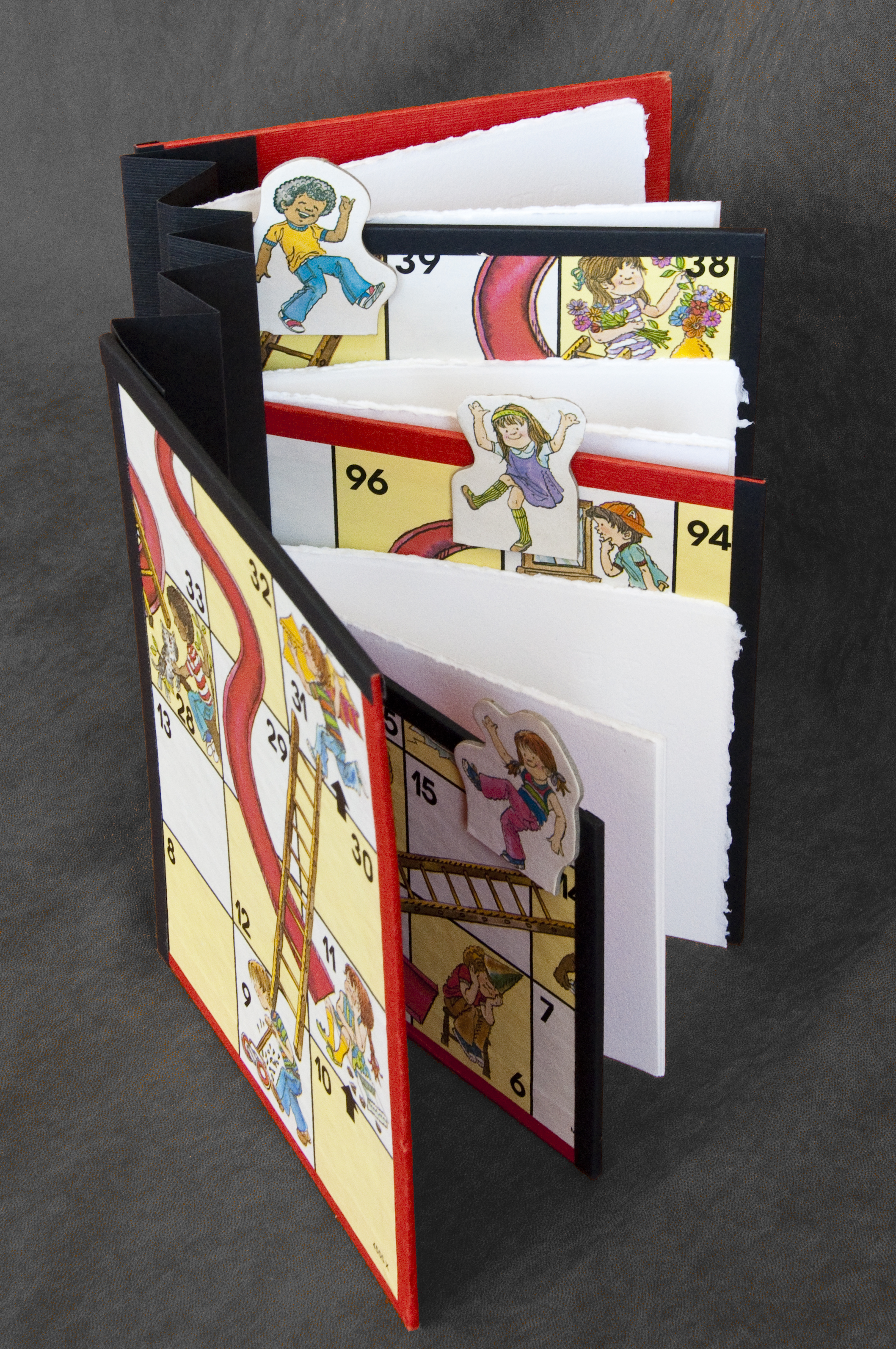
To challenge myself and use up those scraps of Rives, Davey Board and the vintage books and games I can’t resist at yard sales, I’ve decided to teach a class using only recycled and found materials. The class isn’t until September, but the Palo Alto Art Center needed photos to layout the catalog now. So this morning I went to my studio and started sifting through stacks of goodies I can’t seem to part with – the result is the book in the photo above – a re-imagined Chutes and Ladders.

The book is made with an old Chutes and Ladders game, scraps of Rives BFK, scraps of embroidery floss and scraps of black paper. So far so good – I’ve kept to my goal of not buying any materials for this class.

First, to really show off the game board, I decided to used pieces of the board not only as a cover, but also as section dividers. In order to show them off to best effect I made them graduated in height from 4 1/2 to 7 3/4″.  I covered the exposed board edges with thin pieces of black paper wrapped around them like bias tape. Next, to use those cute little game pieces, I decided to use them as “tabs” for my dividers. I glued them using straight PVA.

For the pages I cut three pieces of Rives BFK to the same height as the section dividers and twice as wide. I folded them in half and then used a pamphlet stitch to attach them into an accordion fold spine – so each section has 12 pages. I attached the section dividers and the covers using Terrifically Tacky double-sided tape and there it is, my first entirely recycled book.

I’m happy with the way the design allows the game to remain the focus and it was very fun to make a single book with materials on hand. It was a different exercise in creativity to design around materials I already had rather than design around an idea rattling around in my head. Instead of worrying about getting enough materials for an edition, I could focus on celebrating the materials I had in a single book. I’m looking forward to teaching this class in the fall!

~Ginger

www.gingerburrell.com

Paralyzed by Perfection (Or Turn it 90 Degrees)

I am in denial about being a perfectionist. The first time someone pointed it out, I was shocked – I’m not a particularly neat person (let’s go with “creatively messy”), I’m pretty low-key about many things in life — how could I be a perfectionist? Now, years later, I have to admit that I am, definitely, a perfectionist. Sometimes it serves me well – I have excellent attention to detail, I am willing to put the hours and hard work into a project to make it fit my artistic vision – and sometimes it is a real problem. 

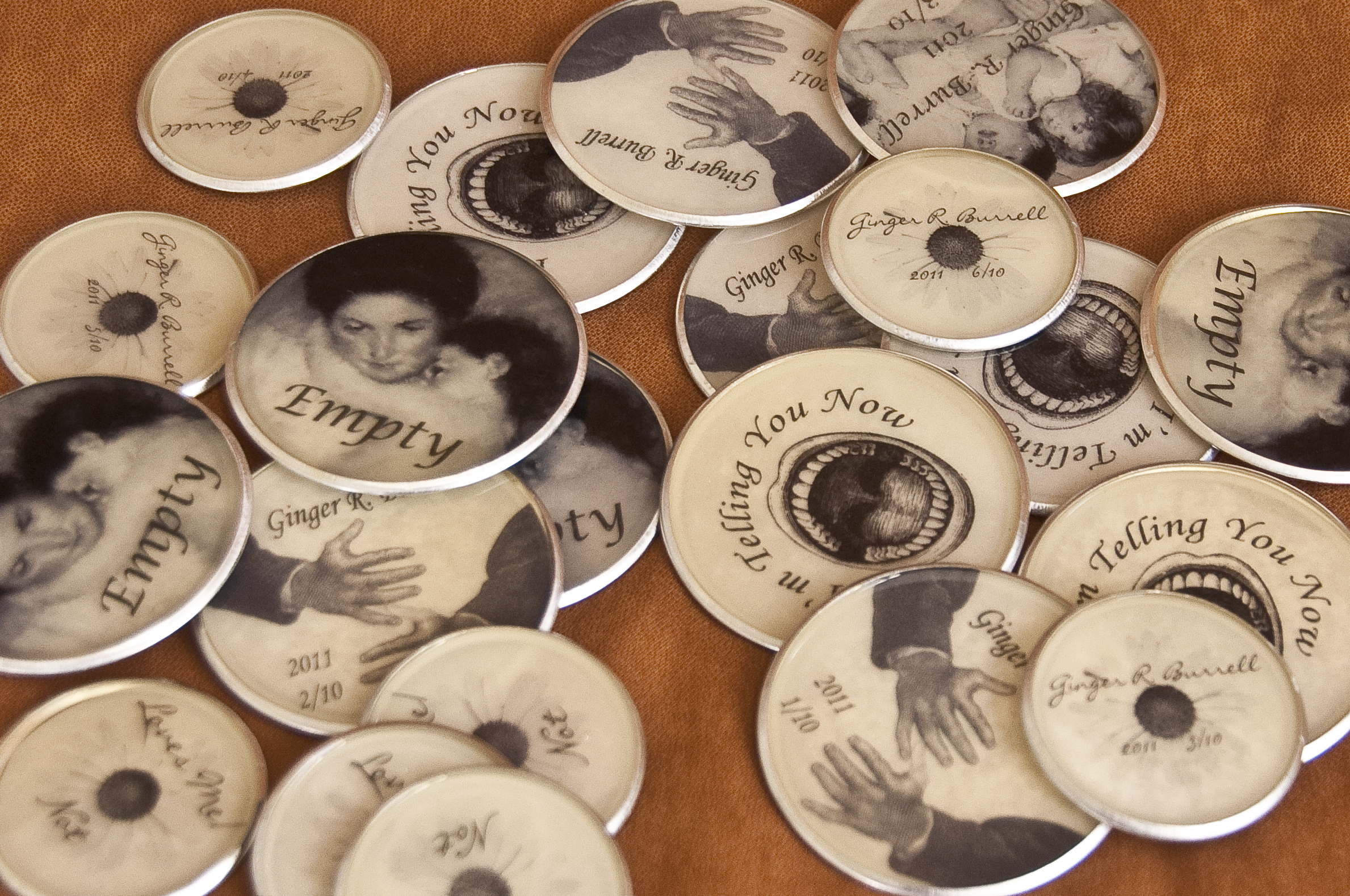
For the past several weeks I’ve been working on the labels in the above photo. It’s a technique using coarse embossing powder to create a translucent shell over an image. In the past I’ve used it to make a translucent disk and, at the beginning of this project, I tried to do that same process. I had all kinds of technical problems, finding a frame large enough (in the past I’d used metal washers), warping during melting, warping during cooling and, once I thought I’d solved those problems, I’d find out my sample pieces were the flukes and I really hadn’t solved the problems at all! To compound the issue, when I attached them to book covers, I realized I didn’t want them translucent after all – the adhesive (and any bubbles) showed right through.

Piles of ruined supplies later, I was so frustrated, I stopped working on my books. I kept missing one self-imposed deadline after another but couldn’t get myself back on track. I also couldn’t let go of that artistic vision that said these books need this kind of label. Sigh.

During this period of paralysis brought on by my own perfectionism, I went to the Maker Faire. If you’ve ever been, you’ll know it’s wonderfully overwhelming with a mixture of creativity that reminds me of a G-rated Burning Man. If you’ve never been, I highly recommend going at least once. They have them all around the country. But I am getting off topic as usual. Squirrel?

Back to the paralysis and piles of ruined materials. During the Maker Faire I had the opportunity to hear Fritz Grobe and Stephen Voltz of EepyBird.com speak. It was a fun and interesting presentation (you can have way too much fun wandering around their website) and, most importantly, they said something that will forever change the way I approach my artistic paralysis. “Turn it 90 degrees.”

Part of their process is to play with materials and, after hours of trying to get sticky notes to act like a slinky with no luck, they had the idea of turning the pad 90 degrees. That simple change (which took them hours to think of) made everything fall into place.

The next day, as I was sitting at the table looking at those labels, I remembered what they said, “Turn it 90 degrees.” Now in my case, turning the labels made no difference, but rethinking them from the ground up sure did. Rather than layering clear material with thin paper and more clear material, I printed on Rives BFK and used the heavy paper as a base with clear material on top. In that one change I solved all of my problems. The labels no longer warp, the adhesive no longer shows through and the paper backing allows for a better bond with the book cloth. Eureka!

Somehow solving that label problem unlocked my ability to solve the other technical problems I’d been having with other materials in these art pieces. Everything has fallen into place and I’m happy to say that I’ve finished almost all of the books I’ve been working on (that I’ve been stuck on, really). I’ll begin introducing them next week.

Thank you Mr. Grobe and Mr. Voltz. I now have a sign in my studio that says “Turn it 90 degrees.” I’m hoping in future moments of perfectionist paralysis that sign will spur my brain to creative mobility.

~Ginger

www.gingerburrell.com

The Joy of Raw Materials – Wet Adhesives (Glue)

Gluing is one of the most necessary parts of bookbinding – and also one of the most stressful. Other than Saran Wrap (which always wraps around me, not whatever I want it to), working with glue is one of my biggest challenges as an artist. I’ve gotten better at it, but I still get anxious at the beginning of a gluing session. All that beautiful book cloth and/or paper just waiting to become a new book, or a glue-y mess that can’t be used.

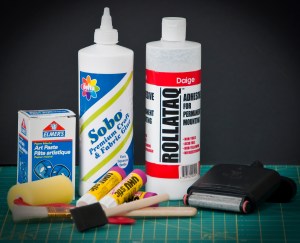
I use four main types of glue. I’ll share my favorites with you — and look forward to your comments.  I think every book artist has very strong opinions about glues. Which ones are the “right” ones to use, which ones are archival, which ones are absolute no-nos. It seems like there is at least an annual discussion on the merits or hazards of YES! glue on the Book Arts List Serv on the Book Arts Web hosted by Philobiblon.

The glue that I use most often is PVA. PVA is, according to Talas’ website, “a general purpose, resin based, internally plasticized polyvinyl acetate emulsion that contains no solvents. It is fast drying, very long-lasting and forms a transparent, flexible film.”  It is pH neutral and acid free. In other words, it won’t yellow and it is considered archival. The brand that I use, because it is readily available at local stores and because I can get coupons for 40% off, is Sobo. I’ve been using it for six years with excellent results. No yellowing, cracking or separation. The artists’ books I created with it six years ago look as good as the day they were made. I use straight PVA to attach sections of books together – for example hinges in an accordion book.

For book covers, I mix PVA with methyl cellulose (also seen as one word, methylcellulose). Again, according to Talas, methyl cellulose “is non-staining, will not discolor paper, will not decompose in dry or liquid state and is not affected by heat or freezing. Forms a highly flexible bond but is a weak adhesive.” Which is why I use it with PVA. PVA is an excellent adhesive but dries quickly. The addition of methyl cellulose allows for good adhesion and a longer drying time. That extra time is precious when working with cover materials that need a little extra manipulation or when the weather is warm.

 Book artists use PVA and methyl cellulose in different ratios depending on preference, humidity and working conditions. I prefer a 2:1 PVA: methyl cellulose ratio. A fellow artist friend, Janice, uses 50:50 to good effect. I use Elmer’s Art Paste brand of methylcellulose after being introduced to it in a class by Laura Russell. As a side benefit the methyl cellulose can be used with acrylic paints to make lovely paste papers.

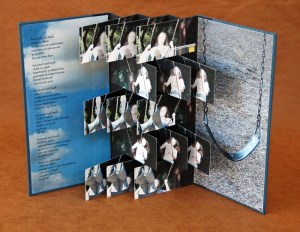
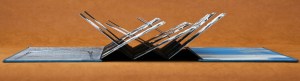
For applications where I need to bond two pieces of paper together – laminate them – and I need the glue to be extra thin and not bleed through the paper, I use Rollataq. This glue is terrific for those applications, such as flag books, where you might want to create two-sided paper – perhaps a photo on one side and a color on the other – by bonding two sheets together. Rollataq sells a hand-held applicator that I’ve found to be invaluable for laying down a thin layer of glue. According to Rollataq’s website, “the glue will not soak through thin papers, will not yellow over time, is acid free and non toxic.” In Pendulum  I bonded paper printed with photos with the same black paper used to make the accordion part of the flag book structure so that the flags look like an integral part of the structure. You can see here that the flags are straight and well-bonded using Rollataq:
Lastly, there is the glue stick. I used glue sticks often when making a mockup or sample of a book I am working on. For quick, mess free gluing, they can’t be beat. I caution against using a glue stick for any application where there will be stress or torque such as an accordion book hinge. Glue stick is meant only for lightweight applications such as a piece of paper with a title to be glued to the front of a small book. In those cases, and when making mock-ups, I use the UHU purple glue stick. I like the purple color because I can see where I’ve put the glue, and I’ve found that this glue stick has the same qualities of any other glue I want for my artists’ books. It’s non-yellowing, acid free and non-toxic.

For gluing advice for adhering almost anything, check out thistothat.com. You can choose what you are attaching (fabric, paper, leather, metal, etc.) to your substrate (fabric, paper, leather, metal, etc.) and then press the “Let’s Glue!” button to get great advice on glue options.

Do you have a favorite glue? Feel free to add your comments.

There’s still time to enter the giveaway drawing for Breakfast. Subscribe by clicking the button to the right by 5/31.

~Ginger

www.gingerburrell.com