
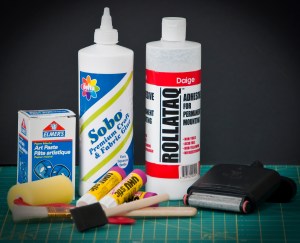
Gluing is one of the most necessary parts of bookbinding – and also one of the most stressful. Other than Saran Wrap (which always wraps around me, not whatever I want it to), working with glue is one of my biggest challenges as an artist. I’ve gotten better at it, but I still get anxious at the beginning of a gluing session. All that beautiful book cloth and/or paper just waiting to become a new book, or a glue-y mess that can’t be used.
I use four main types of glue. I’ll share my favorites with you — and look forward to your comments. I think every book artist has very strong opinions about glues. Which ones are the “right” ones to use, which ones are archival, which ones are absolute no-nos. It seems like there is at least an annual discussion on the merits or hazards of YES! glue on the Book Arts List Serv on the Book Arts Web hosted by Philobiblon.
The glue that I use most often is PVA. PVA is, according to Talas’ website, “a general purpose, resin based, internally plasticized polyvinyl acetate emulsion that contains no solvents. It is fast drying, very long-lasting and forms a transparent, flexible film.” It is pH neutral and acid free. In other words, it won’t yellow and it is considered archival. The brand that I use, because it is readily available at local stores and because I can get coupons for 40% off, is Sobo. I’ve been using it for six years with excellent results. No yellowing, cracking or separation. The artists’ books I created with it six years ago look as good as the day they were made. I use straight PVA to attach sections of books together – for example hinges in an accordion book.
For book covers, I mix PVA with methyl cellulose (also seen as one word, methylcellulose). Again, according to Talas, methyl cellulose “is non-staining, will not discolor paper, will not decompose in dry or liquid state and is not affected by heat or freezing. Forms a highly flexible bond but is a weak adhesive.” Which is why I use it with PVA. PVA is an excellent adhesive but dries quickly. The addition of methyl cellulose allows for good adhesion and a longer drying time. That extra time is precious when working with cover materials that need a little extra manipulation or when the weather is warm.
Book artists use PVA and methyl cellulose in different ratios depending on preference, humidity and working conditions. I prefer a 2:1 PVA: methyl cellulose ratio. A fellow artist friend, Janice, uses 50:50 to good effect. I use Elmer’s Art Paste brand of methylcellulose after being introduced to it in a class by Laura Russell. As a side benefit the methyl cellulose can be used with acrylic paints to make lovely paste papers.
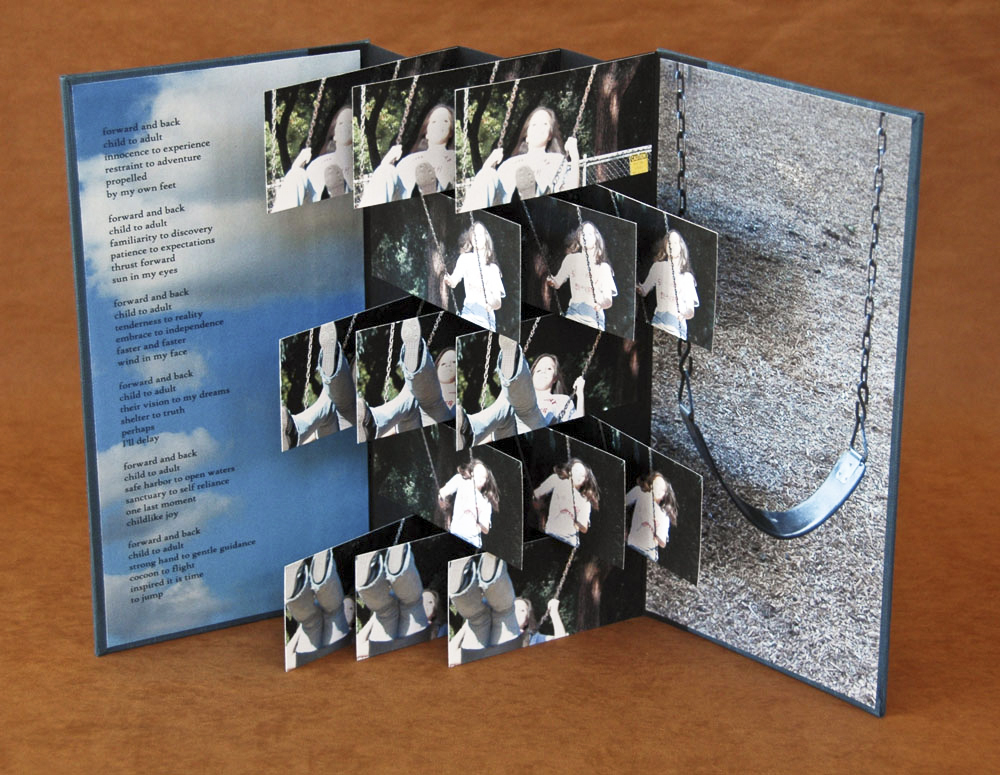
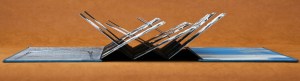
For applications where I need to bond two pieces of paper together – laminate them – and I need the glue to be extra thin and not bleed through the paper, I use Rollataq. This glue is terrific for those applications, such as flag books, where you might want to create two-sided paper – perhaps a photo on one side and a color on the other – by bonding two sheets together. Rollataq sells a hand-held applicator that I’ve found to be invaluable for laying down a thin layer of glue. According to Rollataq’s website, “the glue will not soak through thin papers, will not yellow over time, is acid free and non toxic.” In Pendulum I bonded paper printed with photos with the same black paper used to make the accordion part of the flag book structure so that the flags look like an integral part of the structure. You can see here that the flags are straight and well-bonded using Rollataq:
Lastly, there is the glue stick. I used glue sticks often when making a mockup or sample of a book I am working on. For quick, mess free gluing, they can’t be beat. I caution against using a glue stick for any application where there will be stress or torque such as an accordion book hinge. Glue stick is meant only for lightweight applications such as a piece of paper with a title to be glued to the front of a small book. In those cases, and when making mock-ups, I use the UHU purple glue stick. I like the purple color because I can see where I’ve put the glue, and I’ve found that this glue stick has the same qualities of any other glue I want for my artists’ books. It’s non-yellowing, acid free and non-toxic.
For gluing advice for adhering almost anything, check out thistothat.com. You can choose what you are attaching (fabric, paper, leather, metal, etc.) to your substrate (fabric, paper, leather, metal, etc.) and then press the “Let’s Glue!” button to get great advice on glue options.
Do you have a favorite glue? Feel free to add your comments.
There’s still time to enter the giveaway drawing for Breakfast. Subscribe by clicking the button to the right by 5/31.
~Ginger

 Midnight Musings