Altered Book for Marin MOCA

I’ve always wanted to make an altered book and I’ve started a lot of them. Started being the operative word… Many of my students have made incredible altered books and when I see their work I’m tempted to try again. And then I have another “started” altered book.

This time the starting point was a request by Eleanor Murray of Marin MOCA for their Second Annual Altered Book Show/Auction. Eleanor has always been very kind to me and is a good friend of book arts so I quickly said, “yes” without thinking too much about the “how.”

Again I started a new altered book, I began by gluing pages together and cutting out windows and again I got stuck. I finally realized that my way of working was different and that I needed to figure out a way to alter a book that worked for me.
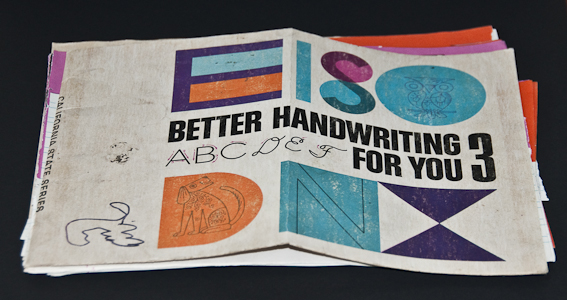
 I’d been making coptic bound books with my students at Palo Alto Art Center and thought that perhaps rebinding  a book was the way I needed to alter it. So I found this book, Better Handwriting for You 3, on a shelf in my studio. As you can see it was barely holding together but I was attracted to the colors and graphic design.


At the same time I found this book, I read an article about how cursive is being dropped from the Core Curriculum of schools all across the U.S. I happen to love handwriting and my mother always encouraged penmanship so I was appalled to see this bit of news. (My husband disagrees and reminded me that he never needs handwriting for his job and can’t even remember how to form a lot of the letters except in his signature.)
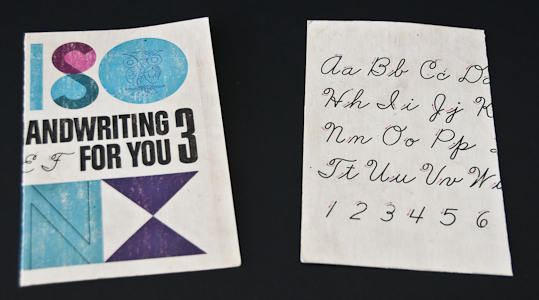
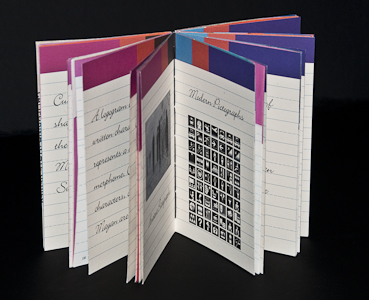
I started by taking the book apart. I created new covers by folding the old ones in half and gluing them together and then I created signatures  by choosing the most interesting inside pages and folding them in half.
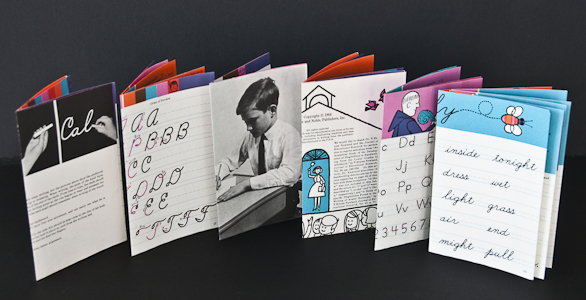
 

I researched writing and human communication and decided to include new content and images about hieroglyphics, cuneiform, typing, etc. in the book. I used Adobe Illustrator to layout pages with the same colors and layout as the original book and then added the new content.

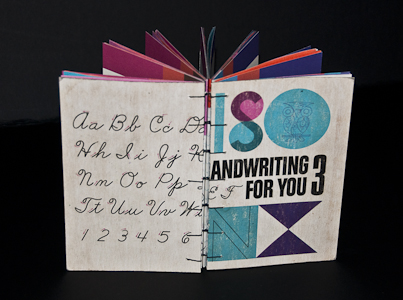


Finally, I rebound the book using coptic stitch and there it is, my first (finished!) altered book.


You’ve Come a Long Way, Baby

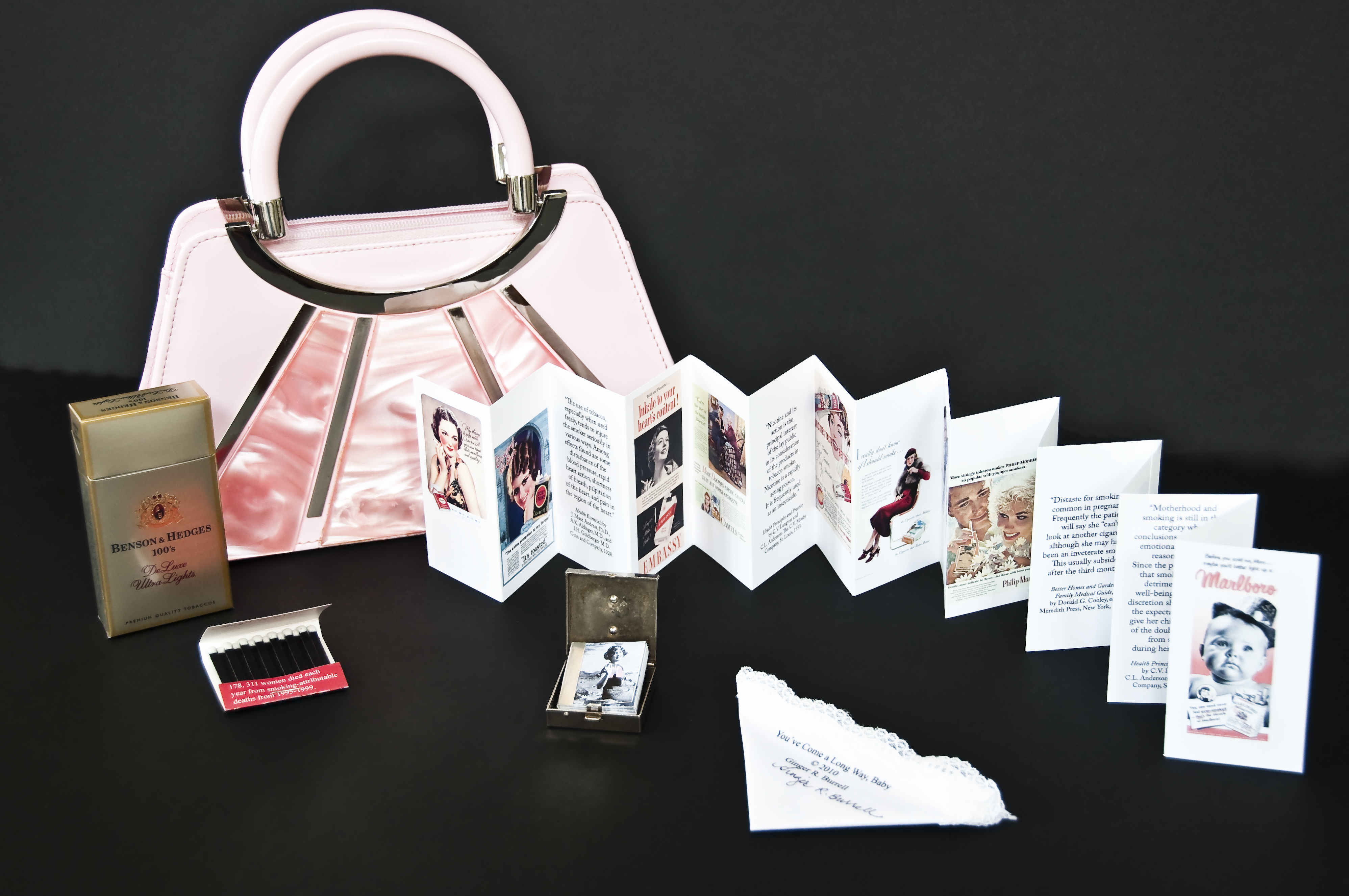
This is a new artists’ book, You’ve Come a Long Way, Baby, that was inspired by an ashtray I found in my grandma’s things after she passed away. You can see the ashtray, open, in the middle, with the little flip book in it. The ashtray, called a Silent Butler, was named after the device used in the late 1800s to collect table crumbs and ashes.

I found the little ashtray interesting and decided to make a book to go in it. One thing led to another and pretty soon there were two books and a custom matchbook that go inside a vintage purse.

The matchbook has a vintage ad on the back and stats on the front about a depressing term called YPLL. Years per life lost. In the case of smokers, the CDC estimates YPLL of 12 years per person.

The cigarette pack has the accordion book inside with vintage advertisements, aimed at women, from the early 1900s to the 1970s juxtaposed with passages from medical books from the same timeframe as the ads. There is a paragraph from a 1960’s era medical book that informs ladies that, although they probably won’t feel like smoking for the first three months of their pregnancies, they’ll be fine to resume in the next trimester.

The book in the Silent Butler ashtray is a flip book with a girl about the age my grandmother was when she started smoking. She is holding a cigarette and as you flip the pages her lungs change from pink to an unhealthy shade. It ends, perhaps a bit melodramatically, with a gravestone.

The last element is a handkerchief I made using printable cotton. It’s quite lovely and took the inkjet printing very well. It has the colophon printed on it along with a dedication to my grandma, Virginia Elizabeth Ginn.

Ode to Anna Atkins

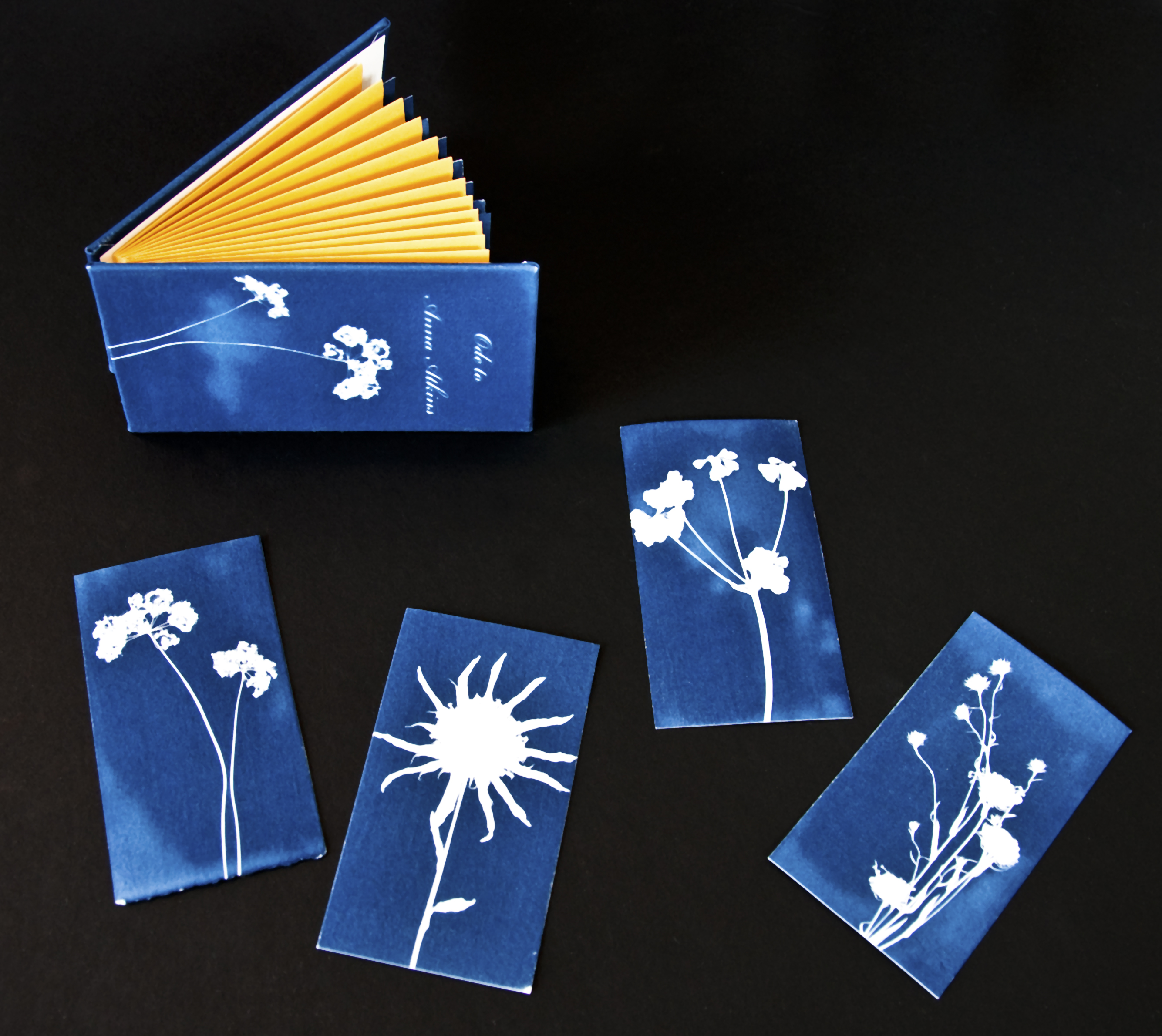
Ode to Anna Atkins is a new artists’ book that I’ve just released. I was fortunate enough to see Anna Atkins’ book, British Algae, while I was in New York. Though made in 1843, the images are still clear, beautiful and delicate. I was thrilled with Anna Atkins book when I first saw photos of it in Art History.  Having the opportunity to actually see it in person – a highlight of my trip to New York.

Empire State Building? That’s nice, honey. Oh, look! Cyanotypes…

My artists’ book is an ode to Anna Atkins using cyanotypes of flowers of Northern California. I just couldn’t get excited about algae. I showed it for the first time last weekend at Roadworks at San Francisco Center for the Book. Everyone loved the tiny little details visible in each cyanotype. The trick, press and dry the flowers first. Fresh flowers have too much dimensionality and create shadows in the cyanotypes. Very flat, very dry flowers are as effective as a digital negative.

The mottled background was very popular, too. I thought a clean blue background would be too one-dimensional with the flat white so instead of applying the cyanotype solution in a meticulous bi-directional two layered process, I used a sponge brush, only brushed in one direction and let the  solution pool slightly in some areas. It looks a bit blotchy in the photo, above, but the actual cyanotypes have more of a subtle morphing of color between areas. I’ve made 3  complete books out of the edition of 10 so I’ve got a lot more cyanotypes to make. Fortunately I love the process and the sound of the water while rinsing the images. It’s kind of like having one of those little fountains in the kitchen – it just happens to have photos in it.

This is a good time, too, to thank Brian Taylor, my alternative processes professor from SJSU, whose enthusiasm for cyanotype was the beginning of my own.