Category Archives: Studio

Unpacking the Boxes: RIP my Beloved HP Printer

After months of planning and packing and two days of moving boxes and wondering where we got all this stuff… we’ve finally moved. I’m looking forward to sharing photos of my new studio with you as well as stories of trying to organize a new space, learning how to work within a new layout and just generally finding my artist self again after months of wearing a movers hat.

In the meantime, here is a quick photo of what we were doing at 6 a.m. this morning after having been up all night (those are Greg’s hands):
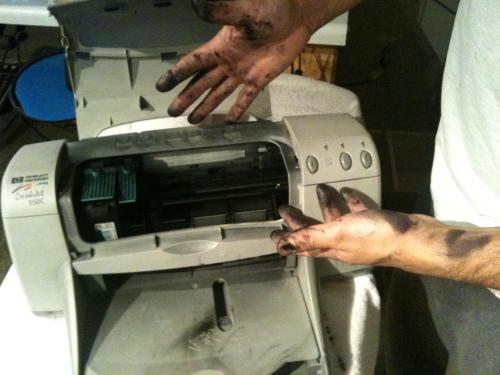
I was finishing up my altered book for the Marin MOCA show and getting ready to print (after finally finding the box that had all the half completed pieces) and Greg opened the box with the inkjet printer in it. I was in the other half of the house and heard a pretty serious verbal SOS. I figure that Greg or one of the cats is hurt (he yelled, “bring paper towels”) so I went running in to the office to see Greg holding my beloved printer with black ink dripping all over him, all over our office chair and all over our new pale sage colored carpet.

Well, I can tell you now, from personal experience, that Shout laundry spot remover, combined with a few rolls worth of paper towels and a Spot Bot, takes black inkjet ink out of pale color carpet.  It took more than an hour, but I was pretty motivated not to have to replace the carpet after only living here a couple of weeks! Sadly, I can also tell you that the printer has finally had it. That $150 printer that was nearly 12 years old has printed every artist book I’ve ever made. It has been a real trooper, printing on Rives BFK, handmade paper, even metal. And it has ink in places we will never reach except when there is valued paper is going through it.

Which brings me back to my book for Marin MOCA. It was meant to be in both black and white and color, but I am left with only my laser printer – which does not print in color. So I did a test print this morning and, to my happy surprise, the book looks better all in black and white. Yes Mom, things do happen for a reason.

I’ll share photos of my altered book tomorrow. I’m pretty tickled with it.

In the meantime I’ll be trying to get inkjet ink out of Greg’s sweatpants and slippers. We think maybe he has scrubbed his fingerprints right off, but his hands are now clean.

Do you have an inkjet story? Feel free to share in the comments.

~Ginger

www.gingerburrell.com

Studio Planning: Inside the Creative Studio

I went to my new studio last weekend (forgot to take a photo, can you believe it?) and it has a roof, is painted on the outside, and even has its own doorbell. How fun is that? We’re about two weeks away from moving in and I realize that I need to finish my space design before it is full of boxes!

My favorite book for studio inspiration has been Inside the Creative Studio: Inspiration and Ideas for your Art and Craft Space by Cate Cioulacos Prato. Greg gave me this book for Christmas and it has been a huge help in making wish lists and designing the floor layout for my new studio.


In addition to the gorgeous photos of studios (or as we call it in our house now, studio eye-candy) this book is full of helpful tips, stories from artists about how they designed and built their studios, and even actual space diagrams. I found the tips from each artist to be especially helpful.

The studio interviews and diagrams are bookended by helpful articles such as “Clutter Out, Creativity In: 10 Steps to a more artful studio” and “For Your Illumination: How to choose the best lighting for your studio” and my favorite,  “101 Organization and Storage Tips.” 

Since we make artists books and paper is one of our favorite guilty pleasures, here are their 10 Best Solutions for Paper Storage (p. 60)

  1. Flat file drawers
  2. Shoe Cubbies
  3. A pretty (or industrial) trash can (for rolls)
  4. Umbrella stand (for rolls)
  5. Large size zipper bags (clip them to cascading skirt/pant hangers)
  6. Wooden clothes drying rack (for rice and tissue papers)
  7. Accordion files (Attach a scrap with the color to the front of each slot or write the name of the color with a permanent marker)
  8. Archival boxes
  9. Plastic protector sheets (magazine cutouts, paper motifs, small images on found papers)
  10. Portfolios for extra-large pieces of paper (You can slide the whole thing under the bed.)

Do you have a book that you can recommend? What tools did you use to plan your studio?

~Ginger

www.gingerburrell.com

Studio Planning: Art Making and Studio Spaces

We’re on the last leg of a long journey towards our new home and my new studio. With any luck at all we’ll be moving in the next couple of weeks. In between packing (and wondering where all this stuff came from) I’ve been looking at books about studio planning.

One of the books I’ve been enjoying was lent to me by one of my students, Viveca.  The book, Art Making and Studio Spaces, by Lynne Perrella, features beautiful and inspiring photographs. Somehow the studios look both organized and yet creatively chaotic at the same time. Since my studio has, up to this point, been more chaotic than creative, I was interested in how other artists organize their spaces so that they are neat but usable.

I was thrilled to see Pam Sussman’s studio. Pam makes artists’ books and the photos of her 1,800 square foot studio show display spaces for her books as well as functionality such as a cart with wrapped bricks to move weights wherever she needs them.

My studio will be just a small portion of that space at 400 square feet, but I’ve been thinking a cart for my Kutrimmer might be just the solution for being able to cut different sized papers – move the Kutrimmer next to a table when I need the extra support, tuck it in a corner when I’m not doing any cutting.

Some of my other favorite studios are Sas Colby’s, with it’s big doors that blur the boundaries between indoors and out, Faye Anderson’s with her large workspace wall to tack up work in progress, and Melissa Zink’s with the rich wood tables, bookcases, flat files and apothecary cabinets.

I can’t do anything about opening up the walls, but a working wall to tack up ideas and artists’ books in progress sounds wonderful and a must add to my new studio. I’d love to add some of the rich woods, too. Most of my studio furniture is white, very functional, but lacking history.

This  book is certainly eye candy for artists. The studios themselves look like works of art. You may have to stay up all night redecorating your studio after looking at this book.

~Ginger

www.gingerburrell.com