Setting Up a Custom Google Alert for Artists Books

x

Every day I get three emails from Google Alerts. Google Alerts monitors the web for new content in areas I’m interested in. One is set up for “artists books” and one is for “handmade books.” Sometimes there is nothing worth mentioning in these emails, but sometimes, like today, there were some real treasures. And, often by beginning with these links, I wander into something even more interesting.

The third is for “Ginger Burrell.” Why my own name? As artists we send things out all over  – to galleries, to collectors, on the web. Keeping track of how your work is being used or being talked about is important and nearly impossible without search tools. Google Alerts helped me find this review by Lark Magazine which included a nice mention about The Heaven Project and this mention by Denison Library about adding my book, Hands, to their collection.

Today’s goodies include:

In the “handmade books” alert, a link to Huldra Press about using a sketchbook and a link to a video version of an artist’s book by Theodore Lalos.

In the “artists books” alert, there was a link to a video by Travis Shaffer: Artist’s Book: conceptual and a link to a blog about the London Art Book Fair by Artypeeps which, when following the sidebar links led me to Artypeeps Artists’ Books page and ultimately to the treasure of the day:

The August/September issue of the Book Arts Newsletter edited by Sarah Bodman and published by the Centre for Fine Print Research, Department of Creative Arts: Book Arts, at the University of West England. And that lead to the September/October issue. Grab a cold drink (it’s going to be 100 degrees here) and stay a while. These two newsletters have seventy-seven (77!) pages of book arts information. It will take a while to load but it’s well worth it – you will be inspired.

Interested in setting up your own Google Alerts? Use this easy form.

~Ginger

www.gingerburrell.com

What is an Artist(‘)s(‘) Book?


As I mentioned in my last post, I think an interesting part of being an artist is learning about what has come before. I know there are a group of artists who think that art history is a waste of time and we shouldn’t care what happened in art before they came along. I respectfully disagree.

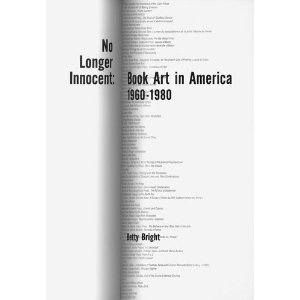
So, I thought I’d share with you about No Longer Innocent – Book Art In America 1960-1980 as I read it. If you’ve read it, or this makes you curious enough to pick it up, let’s discuss it as we go along.

Obviously I can’t outline the whole book for you as I’m sure that Ms. Bright would not appreciate that. You’ll have to read the book. But, I have to admit, it’s very interesting reading so I’m hoping to tempt you to try it for yourself. If you learn something along the way, so much the better. I can tell you that after having read only two chapters so far, I feel like I have a much better understanding of the Book Art world and its history. Whereas I was dreading beginning the book, I’m now looking forward to the next chapter.

So, here we go:

In the introduction, Ms. Bright talks about the pre-occupation, by both artists and galleries/museums about the definition of artist’s books. And, she’s quite right. If you belong to the Book Arts ListServ you’ll know that this discussion comes up regularly. What is an artist book? Does the apostrophe go in front of or after the s? (Artists’ book or artist’s book?), etc. I’d recently read Alisa Golden’s discussion in her blog called, Defining Book Art: What’s in a Name?, and loved her last sentence, “I sigh and say, ‘look at my website.'”

Then, out of curiosity, I Googled “What is an artists book” and found that this is a subject written about over and over by book artists and libraries. Here are some of the more interesting blogs I found:

Artist’s Books – For Lack of a Better Name by Angela Lorenz (I love her opening statement: “WARNING: Artist’s books should come with a warning label. Once you know what they are, be warned, you have the burden of trying to explain them to others.” I also particularly like her list of what artist’s books are not.)

On the Book Arts Web, you’ll find a discussion thread from March 1998: Definition of the Artist’s Book; What is a Book, BSO’s (Book Shaped Objects); Art vs. Craft. (BSO was a new term for me. One of my favorite posts in this thread includes the questions: What is an artist? How do we define “read”?)

And, in case I haven’t lost you yet, here are several more:

What is an artists’ book by the State Library of Queensland

Artists’ Books by the Victoria and Albert Museum

What distinguishes an artist’s book from an art book? by the Lucy Scribner Library (While you’re there, use the sidebar on the right to browse their collection of 100 Artists’ Books. You’ll be inspired.)

What is an Artists’ Book by the Oberlin Art Library

Squirrel? I didn’t actually tell you much about Ms. Bright’s book, but I think this post is long enough. Already we’ve launched off into researching and pondering – which is the point of studying anyway.

How do you define an artists’ book? Please feel free to share in the comments.

~Ginger

www.gingerburrell.com

Learning about What Has Come Before: Book Art in America

When I was at San Jose State University, some of my favorite classes were art history. I know. Snooze. But I had the gift of three amazing professors who love art history and made me  love it, too.

Dr. Max Grossman’s enthusiasm for art history was a defining moment for me. What seemed dry and drudgery became interesting, even compelling. In his Medieval to Renaissance class, Dr. Grossman talked about the art and artists as if he had been there. His knowledge of the backstories of great works of art made them come alive and had a lasting effect. Now at museums I recognize work we talked about, I understand its place in the history of art, and its significance to work that followed. I’ve become a better consumer of art because I’m more educated.

Dr. Dore Bowen‘s class Contemporary Art: The Thing sounds like a good name for a horror flick. Instead it was a thought-provoking journey through the art world from Duchamp’s Fountain to Jeff Koon’s Puppy and far beyond. And, while I didn’t always like the art (or even agree that it is art), I did learn to really think. Not just about the visual impact, but also about the intent of the artist, the social and cultural context when the art was made, and the influence of that art on all that follows. This class also led to two of my artists’ books, Rocks and You’ve Come a Long Way Baby.

Brian Taylor‘s History of Photography changed everything for me. I’ve loved photography since I was a little girl (I have the “heads cut off” photos to prove it) but, until this class, I had no idea about the incredible artistic range of this medium I thought I was good at.  As I learned about Anna Atkins, Edward Steichen, Imogen Cunningham,  Jerry Uelsmann, Alexander Rodchenko and too many others to name here, I realized that I knew nothing about photography and that I need to begin again. This class also led to new work including The Heaven Project and Ode to Anna Atkins.

Why have I spent four paragraphs reminiscing about art history classes? This rather long-winded introduction leads me to my current foray into art history, reading No Longer Innocent: Book Art In America 1960-1980 by Betty Bright. I’ve had this book on my shelf for quite some time but I’d never actually opened it. One day I realized how much I was missing the reading and discussions from school and decided that this book would be a good start. I know a lot now about the histories of painting, sculpture, photography, but what do I really know about the history of my own media, book arts? So here goes, a self-directed art history class about book arts. I suspect, as the above mentioned classes changed how I view and make art, this book will also have an impact. I invite you to read along with me and join the discussion.

~Ginger

www.gingerburrell.com