The Joy of Raw Materials – Rives BFK

One of the joys of being an artist is choosing the raw materials for art. Like a chef choosing the just the right spices for a delicious meal, artists delight in considering every ingredient. I think for book artists, paper may be our greatest pleasure (although I’m already arguing with myself over the possibility that it may be bookcloth). Every detail, the weight, feel (or hand), color, and pattern – even the edges, deckled or not, is taken into consideration when choosing paper for a new artists’ book.

My favorite paper, and one I return to often, is Rives BFK. A printmaking paper, Rives BFK has no sizing and has a fabric-like hand. I think that part of experiencing an artists’ book is the feel of the pages when you are turning them and Rives BFK is always a pleasure. I began using it for litho, etching, and intaglio but now use it for cyanotype and inkjet printing.

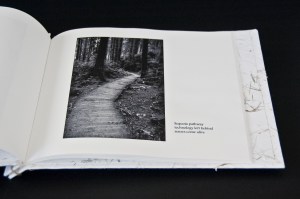
Rives BFK takes inkjet printing beautifully, but because there is no sizing, the ink sinks right in. To get a wide range of tonality in photographs, I use a low ink volume setting. This allows the ink to float on top of the paper and I’m able to bring out silvery gray values in black and white photographs. I’m often asked about getting the best quality print out of a printer and I recommend that you test print each type of paper you’re using with each option in your print dialog box. Print>Properties: experiment with combinations of print quality, paper type and ink volume. The investment in a few extra pieces of paper and a bit more ink will payoff in print quality. Here is an example page from Virtual/Reality:
Rives BFK also allows for double-sided printing without a hint of what is on the other side of the page. Although that can certainly be an interesting design element, I usually want my page to present only a single (or set) of images at a time. I don’t want distractions. In most cases I use BFK sheet, 250 gsm in white.

What is gsm? (When I started out writing this blog entry I had only a vague idea  so I did some research. I found it interesting and hope you do, too.) Gsm, also seen as g/m , is the weight or grams per square meter. The higher the gsm, the thicker the paper. According to Paper Mojo, “The European mesaurement of describing paper weight measures a single paper with a two-dimensional height and width of one square meter.”  You might want to take a look at their paper weight conversion chart.

Another challenge with Rives BFK is gluing. Flat gluing is easy. Gluing, as for a book cover, when you are folding the paper around Davey board, is a bit more challenging. Because Rives BFK has no sizing and is therefore more absorbent, the glue sinks into the paper and does not sit on the surface. This reduces the tackiness that makes the paper stick to the board when wet. Invariably the first time I tried it was late at night before a deadline and I was almost in tears with frustration – I pulled out the scotch tape and taped the edges of the paper around the back of the board while the glue dried. Before gluing in the final backing pieces, I removed the tape. This now my standard procedure when using Rives BFK as cover paper as in Ode to Anna Atkins:

Lastly, Rives BFK takes and holds a fold beautifully. Folding along the grain creates a crisp, flexible fold. This paper works especially well for post- and Japanese stab bound books for this reason. For best results, pre-score the paper before folding it.  I’ve also found it to be very nice for accordion books – the weight gives it enough stability to display well while open.

I’d love to hear your opinion about Rives BFK – or your favorite papers. I’m always looking for new ones to try.

~Ginger
www.gingerburrell.com

Production Notes (or making an edition of artists’ books)

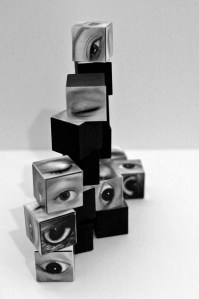
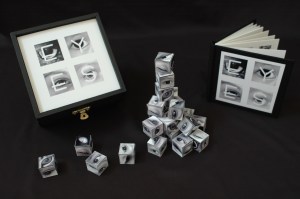
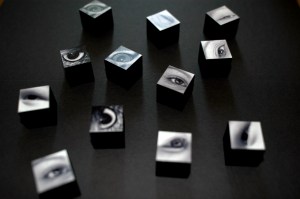
This week I finished the last of the EYES edition. I’d forgotten how long those little EYES cubes take to make. Painting the cubes, cutting out those little EYES photographs, painstakingly gluing each photo to each face of every cube. Meditative in a way. And, while I was painting and cutting and gluing I was already working on new artists’ books in my head.

In the past I’ve made my artists’ books as I need them. EYES was an edition of 10, I made two in the edition to start and have made one or two at a time since. Now that I’m sending the last three in the edition to Vamp & Tramp, I can’t help but think that maybe I should make all of the new work as complete editions. If there is 1o in an edition, make all 10 at once.

My editions are never very big, 25 at the most. Often 5 or 10. Part of the reason is that I have more ideas than I have time to make books and another reason, quite honestly, is that I get bored with making the same book. I love the process of making artists books, the first thrill of a new idea, the excitement of picking every detail:  what structure, creation of the content, the book cloth or paper to cover the book, whether it will have pieces to play with like Rocks or be a more contemplative and traditional book like The Heaven Project. I even love the frustrations, or more specifically the aha! moment, when the problems that plague a book are solved.

So as I get ready to start new work, I’m wondering should I make it all at once? It would be nice to have it all ready to send out without any lead time and it would be nice not to try to find paper, cloth or some other essential for an edition when it turns out I need more than I planned. But would making and storing the books all at once reduce my relationship with the art? Has making EYES cubes over the years helped me bond with the book and keep it close to my heart?

What do you do? Do you make all of the artists’ books in an edition at once? 

~Ginger

www.gingerburrell.com

Preserving Family History in an Artists’ Book

In a box in the bottom of my studio closet was an old, tattered quilt made by my great-grandmother. The quilt is worn through to the backing in places and has stuffing bits showing through here and there. When I found it as a child it was probably in good condition – but I fell in love with it and used it for everything from cuddling on the couch, to wrapping up my cat like a baby, to making a fort over the grand piano.  I didn’t understand that this was an heirloom to be preserved and instead dragged it from adventure to adventure in between stops to the washer and dryer.

Would my great-grandmother have saved it for good? Or felt that it was a useful item that would be wasted if carefully folded in the linen closet? I didn’t know her and I can’t answer that question. But I can see in the thousands of little hand sewn stitches that she took pride in her quilting and spent a lot of her precious time creating this work of art.

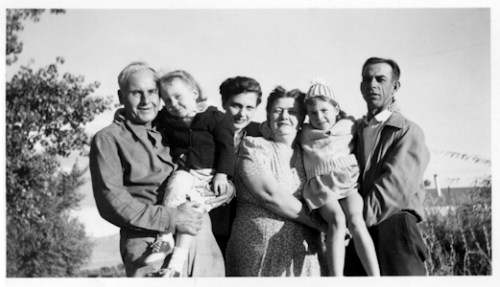
[My great-grandmother (center in flowered dress) circa 1946]

I’ve often thought about ways to give the quilt another life but have eventually returned it to the box each time. I found it again during my studio clean out and am finally ready to make the quilt into artists’ books. I like the idea that by creating artists’ books with the quilt it will continue as art – just in a different form.

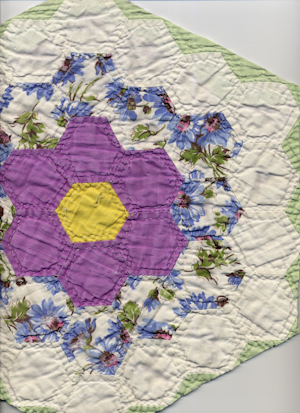
To start out, I did some research. It turns out this particular kind of quilt is called a Grandmother’s Flower Garden quilt. A pattern that was popular 1929-1939 since it could be made out of small scraps of fabric such as feed, flour and sugar sacks and bits of leftover dress material. For a generation of women making do during the depression, this was the perfect quilt pattern.

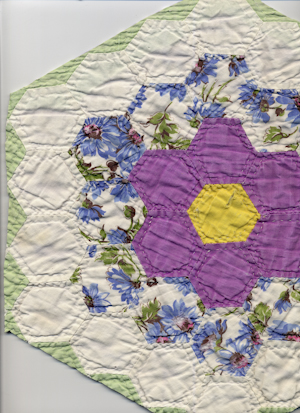
First, I cut the quilt into manageable pieces and now I’m scanning it 1/2 a piece at a time.


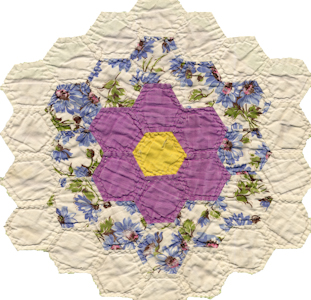
Next, I am merging the two halves in Photoshop. This is one of my favorite bits of magic with this software. In Adobe Photoshop (my version is CS3), File>Automate>Photomerge. A bit more editing to color correct the image and then cropping to remove the green edges and here is one of the raw images from which I am going to begin my artists’ book.

~Ginger

www.gingerburrell.com