Tag Archives: Ginger Burrell

What Do Your Entry Fees Pay for When You Enter a Juried Show?

Participating in gallery shows can feel like one expense after another for an artist. Not only are we paying entry fees for most shows, but we’re also paying for shipping to (and maybe from), packing materials and, if we’re fortunate enough to sell something in the show, we’re paying a percentage to the gallery. Often we enter shows and get little to no feedback about the process, our artwork, or the response to our work. In fact, in general, the gallery system is quite mysterious.

As book artists, we’re very fortunate to have gallery owners like Laura Russell who are willing to take the time to explain how galleries work. Laura, who runs 23 Sandy Gallery, is always gracious and patient. After our recent email exchange Laura used her own blog to answer my questions about what the submission fees pay for when you enter a juried show.

Some of the expenses seemed obvious, such as postcard printing and mailing, but others less so – such as paying a programmer to create the online forms we artists use to apply to the shows.

I think you’ll find Laura’s answer interesting. You can read the full text of her answer here.

And while you’re at the blog, take a moment to wander around the 23 Sandy Popular Postings (top right column), you’ll see more information that galleries rarely share with artists.

As always, thank you Laura.

~Ginger

www.gingerburrell.com

Having Fun with Art History at Khan Academy (Not just for kids!)

I was reading Wired Magazine the other day (the July issue to give you an idea how behind I am on everything) and I came across an article entitled, “How Khan Academy is Changing the Rules of Education.” Well since my background is in education and I have lots of kids in my life who are in school, I read it from beginning to end. It’s interesting, worth the read. Go ahead, I’ll pause while you read it…

When I finished the article I went to my computer and surfed over to the Khan Academy website to check it out for my niece, Marisol, who helps me keep my brain nimble by helping her with homework. Algebra, check, science, check. I’ll have to share this website with Mari, I thought.

Then I scrolled down a little further and I was surprised and tickled to find a section on Art History. Art History! One of my favorite subjects. Now I know from chatting with a lot of my artist friends that art history is not always a favorite topic, but I have to tell you, after checking out the Art History section of Khan Academy, you’ll might just change your mind. The videos are short, informative, conversational in nature, and will teach you a lot in a little bit of time.

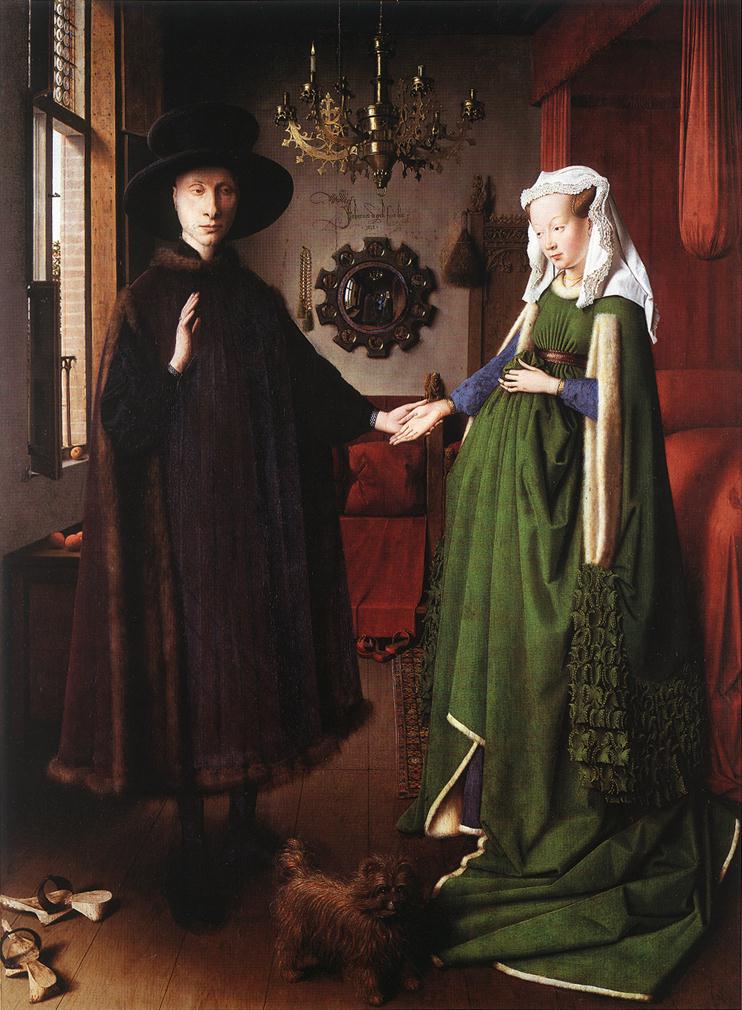
At first I wandered through some of my favorites that I knew I would enjoy – and maybe learn a bit more about: Van Eyck’s portrait of Giovanni Arnolfini and his Wife, Gaugin’s The Red Cow, and Millet’s the Gleaners.

And then, to challenge myself I tried an artwork that I don’t like very much but am open to the idea that my lack of education may affect my ability to understand it: de Kooning’s Woman I (Nope, no change, I still don’t like it, although I did learn a lot.)

It was tempting to spend hours going from one artwork to another but I think I’ll just add this website to my daily routine. One work a day.

While you’re there, check out the brain teasers, math, science and other topics. After sampling a few of the math videos I thought perhaps I’d like math a lot more if I’d learned it this way. There are even sections on Banking and Money, the Credit Crisis, Currency and Current Economics. Probably something we should all understand better. After I work through the Art History Section I’m going to check out the Astronomy.

Do you have websites that you use for your art education? Please post web links in the comments and tell us why you like that site.

~Ginger

www.gingerburrell.com

Paper Storage: An Alternative to Flat Files

One of the many challenges of being an artist is storing supplies and, for book artists, that means paper. Do we roll it up? Lay it flat? And where in our studio do we store paper without exposure to dust, bugs and other troublesome elements?

Ideally I think we’d all love to have a nice set, or three, of flat files. Big, flat, thin drawers to cradle all of that beautiful paper that we just can’t resist. If you’ve ever been to the annual paper sale at Flax in San Francisco, you’ll know exactly what I mean. It’s such a deal, why not buy more? Because you have to store it somewhere.

I agonized over whether I could afford flat files (I tried Craigslist and Freecycle in addition to art and office supply stores, I even tried school suppliers hoping that they might have a bit more of a bargain for classroom storage) and, even if I could afford them, would they fit in my studio, a 10 x 10 bedroom? The only option was to remove my work table and use the top of the flat files as workspace.  I didn’t really like this idea and thought long and hard about what I truly needed.

I realized that because of the size limitations of my computer printer it was unlikely that I would ever make artists’ books that would need full sheets of paper. This changed the size of the paper that I needed to store from 22 x 30 to half sheets of 22 x 15. I knew I wanted drawers, not containers with lids, so that I could stack them and not have to move anything to get to the paper. I do enough of that shuffling around already in my studio. I scoured the local stores and the internet for a product that would work.
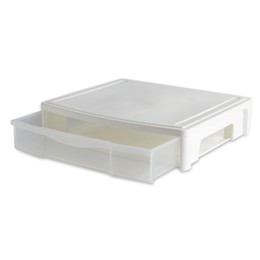
Enter the Wide Underbed Drawers from the Container Store. These stackable drawers are 23 x 27 x 6.5 high and easily hold half sheets of pretty much any paper I’ve bought. It turns out that 6 of them fit neatly between my upper and lower linen closets. Aha. Instant flat paper storage for a pittance compared to the price of flat files. $150 for six drawers (38 ” of stacked height) instead of the $500-$1500 I would have paid for flat files. Even better, by ordering online and picking up at my local Container store, shipping is free and they brought the items to my car. Now that is customer service.
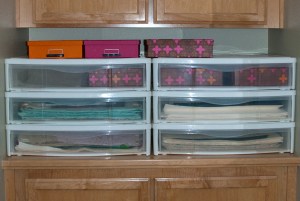
I’ve had my stacking drawers for more than a year now. I’m very happy with the size, the ease of stacking and the amount of paper I can fit in the drawers. They are easy to open and close and do not jam. Because of their height, I am able to store boxes in the drawers to divide the paper. For example, if I’ve cut Rives to 8.5 x 11 grain short and Rives to 8.5 x 11 grain long I want to be able to store them separately but I don’t want to use up a whole drawer for just one stack. I use the Stockholm Office Boxes, also from the Container Store, to hold smaller sheets inside the larger drawers. (Just to be clear, I have no affiliation with The Container Store, I just love these products enough to recommend them.)

I have no idea yet where this flat paper storage will go in my new studio, but because of their stackability there is a lot of flexibility, certainly more than if I’d purchased flat files.

A friend of mine, Kitta, stores hers in rolls in a wine rack turned on it’s back, another friend under her bed. How do you store large pieces of paper for your art?

~Ginger

www.gingerburrell.com